Wednesday, 19 October 2016

Tuesday, 18 October 2016
Wednesday, 12 October 2016
Saturday, 8 October 2016
Friday, 7 October 2016
Introduction to Ratio
Ratios
A ratio compares values.
A ratio says how much of one thing there is compared to another thing.
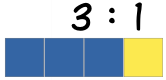
There are 3 blue squares to 1 yellow square
Ratios can be shown in different ways:
| Using the ":" to separate the values: | 3 : 1 | |
| Instead of the ":" we can use the word "to": | 3 to 1 | |
| Or write it like a fraction: | 31 |
A ratio can be scaled up:
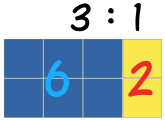
Here the ratio is also 3 blue squares to 1 yellow square,
even though there are more squares.
Using Ratios
The trick with ratios is to always multiply or divide the numbers by the same value.

Recipes
"Part-to-Part" and "Part-to-Whole" Ratios
The examples so far have been "part-to-part" (comparing one part to another part).
But a ratio can also show a part compared to the whole lot.

Try It Yourself


What is the ratio of oranges to strawberries? : 
What is the ratio of strawberries to oranges? :
What is the ratio of oranges to total fruit? :
What is the ratio of strawberries to total fruit? :
© 2015 MathsIsFun.com v0.91
Scaling
We can use ratios to scale drawings up or down (by multiplying or dividing).
The height to width ratio of the Indian Flag is 2:3
So for every 2 (inches, meters, whatever) of height
there should be 3 of width. |  |
If we made the flag 20 inches high, it should be 30 inches wide.
If we made the flag 40 cm high, it should be 60 cm wide (which is still in the ratio 2:3)
| |
Linear equation
A linear equation is an equation for a straight line
These are all linear equations:
| y = 2x + 1 | 5x = 6 + 3y | y/2 = 3 − x |
Example: y = 2x + 1 is a linear equation:
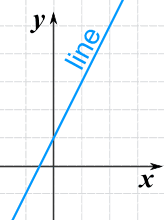
The graph of y = 2x+1 is a straight line
- When x increases, y increases twice as fast, hence 2x
- When x is 0, y is already 1. Hence +1 is also needed
- So: y = 2x + 1
| x | y = 2x + 1 |
|---|---|
| -1 | y = 2 × (-1) + 1 = -1 |
| 0 | y = 2 × 0 + 1 = 1 |
| 1 | y = 2 × 1 + 1 = 3 |
| 2 | y = 2 × 2 + 1 = 5 |
Different Forms
There are many ways of writing linear equations, but they usually have constants (like "2" or "c") and must have simple variables (like "x" or "y").Examples: These are linear equations:
 |
y = 3x − 6 | |
|
y − 2 = 3(x + 1) | |
|
y + 2x − 2 = 0 | |
|
5x = 6 | |
|
y/2 = 3 |
- Exponents (like the 2 in x2)
- Square roots, cube roots, etc
Examples: These are NOT linear equations:
 |
y2 − 2 = 0 | |
|
3√x − y = 6 | |
|
x3/2 = 16 |
Thursday, 6 October 2016
Fraction
Fractions
A fraction is a part of a whole
Slice a pizza, and we get fractions:
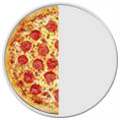 | 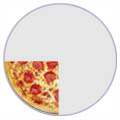 | 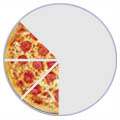 |
| 1/2 | 1/4 | 3/8 |
(One-Half)
|
(One-Quarter)
|
(Three-Eighths)
|
The top number says how many slices wehave.
The bottom number says how many equal slices it was cut into.
The bottom number says how many equal slices it was cut into.
Have a try yourself.
Thanks
Decimal
Decimals
A Decimal Number (based on the number 10) contains a Decimal Point.
Now, let's discover how it all works ...
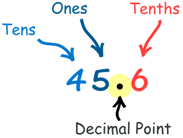
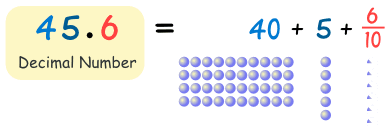
Place Value
It is all about Place Value !
When we write numbers, the position(or "place") of each digit
is important.
is important.
- the "7" is in the Ones position, meaning 7 ones (which is 7),
- the "2" is in the Tens position meaning 2 tens (which is twenty),
- and the "3" is in the Hundreds position, meaning 3 hundreds.
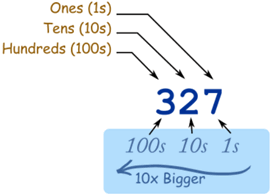 |
| "Three Hundred Twenty Seven" |
 | As we move left, each position is 10 times bigger! |
| Tens are 10 times bigger than Ones Hundreds are 10 times bigger thanTens |
... and ...
| As we move right, each position is 10 times smaller. |  |
| From Hundreds, to Tens, to Ones |
 | But what if we continue past Ones? What is 10 times smallerthan Ones? 110ths (Tenths) are! |
| But we must first put a decimal point, so we know exactly where the Ones position is: | 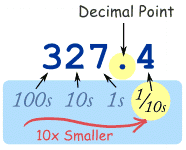 | |
| "three hundred twenty seven and four tenths" but we usually just say "three hundred twenty seven point four" | ||
Subscribe to:
Posts (Atom)